
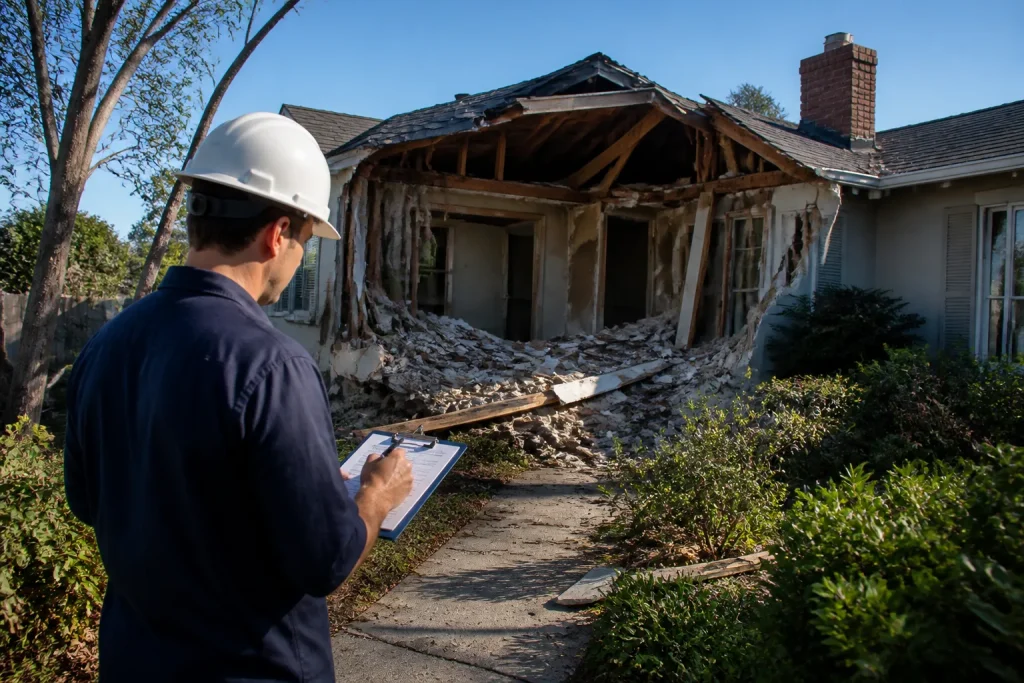
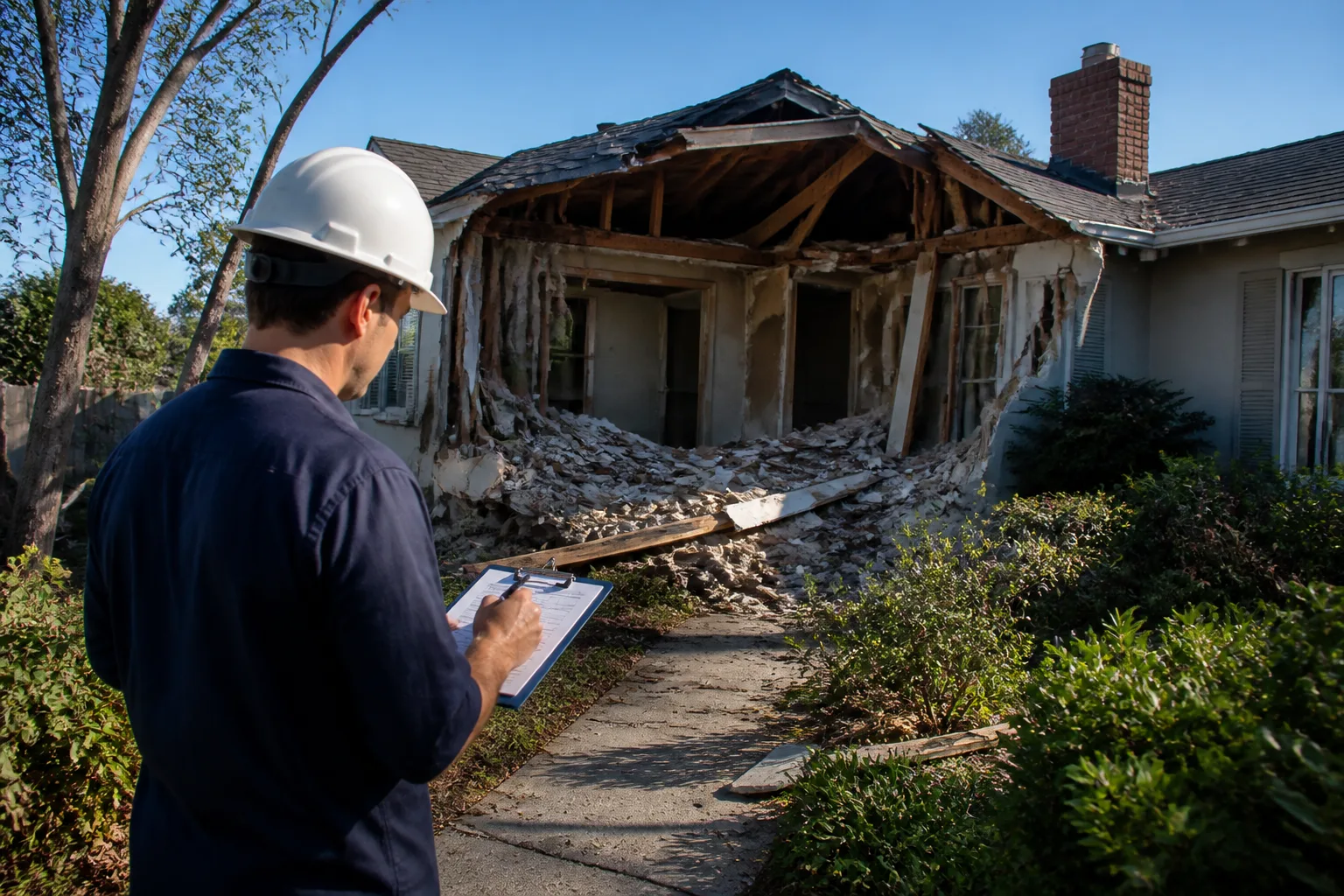
Emergency General Contractor Near Me: What Los Angeles Homeowners Should Do First
In the first hour after a burst pipe, a partial roof collapse, or fire damage, the decisions you make determine whether your insurance covers the repair fully or partially. Most LA homeowners don’t realize that hiring the wrong contractor first, or signing the wrong authorization, can compromise a claim before a general contractor even touches the wall. Here’s the correct sequence: stop the source, document everything with photos before you move anything, call your insurer to open a claim number, then bring in a contractor. If you’d rather not navigate this alone, call (949) 850-9896 and our team will walk you through it.
A water damage restoration company that shows up within the hour and asks for an assignment-of-benefits signature before your insurance adjuster has seen the damage has just shifted control of your claim. That signature is difficult to undo. We’ve watched Los Angeles homeowners lose thousands of dollars because they signed paperwork in the chaos of the first hour, before anyone had explained what the terms actually meant.
The First Four Hours: A Sequence That Protects Your Claim

When water is pouring through a ceiling or a section of roof has given way, your instinct is to call someone, anyone, who can make it stop. That instinct is right. But the order of who you call matters more than most Los Angeles homeowners realize, because insurance adjusters look at what happened in those first hours when they evaluate a claim.
Here’s the sequence we recommend, refined from years of helping families in Los Angeles recover from water, fire, and structural emergencies:
- Stop the source before anything else. Shut off the main water valve if you have a burst pipe. Shut off power to affected areas if water has reached outlets or panels. If there’s a gas smell, leave the house and call your utility company from outside. No contractor can help you until the source is stopped.
- Photograph everything before you touch anything. Your phone camera is the most important tool you own in this moment. Wide shots of each room, close-ups of the damage, the water line on the drywall, the contents that got wet. You’ll need these for the adjuster, and you’ll be glad you took them before anyone moved a wet couch off the hardwood.
- Call your insurance company and open a claim number. Not your agent’s voicemail. Not a text. Call the claims line, get a claim number, and write down the name of the person you spoke with. This claim number is what every contractor, adjuster, and restoration company will reference from this point forward.
- Then call a general contractor. Not a restoration company that showed up on your doorstep. Not a crew that happened to be “working in the area.” A licensed Los Angeles contractor who can document the emergency stabilization work separately from the permanent repair work, because that separation matters for your reimbursement.
We pulled a drowned Shop-Vac out of a garage over in Sherman Oaks a few years back where the homeowner had called a restoration crew before his insurer. He signed their work authorization on an iPad while standing in two inches of water, and by the time his adjuster arrived two days later, the crew had already torn out drywall the adjuster wanted to photograph. His payout was reduced because the evidence was gone. Don’t let that be you.
What an Assignment-of-Benefits Clause Actually Means in Los Angeles
An assignment-of-benefits, or AOB, is a legal document that transfers your insurance claim rights to a contractor or restoration company. Once signed, the contractor can bill your insurer directly, negotiate the claim, and in some cases file suit against your insurer without your involvement. That sounds convenient in the moment, and sometimes it is. Other times, it means you’ve handed control of your money to a company you met twenty minutes ago.
On a standard Los Angeles homeowner’s policy, signing an AOB before your adjuster has inspected the damage can reduce your payout in ways you won’t see coming. The contractor and your insurer may disagree about scope, about pricing, about what counts as emergency work versus permanent repair. When that dispute happens, you’re no longer in the middle of it. You’re at the edge of it, watching. And if the contractor’s bill exceeds what the insurer approves, the difference can become your problem, not the contractor’s.
Some legitimate restoration companies use AOBs appropriately. Some don’t. Our guidance is simple: don’t sign one until your adjuster has reviewed it and your claim number is in hand. If a contractor pressures you to sign before the adjuster arrives, that pressure is information. Act on it.
Red Flags in the First Phone Call
- They promise to “handle everything” with your insurance before asking for your claim number.
- They use the phrase “we’ll deal with the insurance company for you” before you’ve even opened a claim.
- They ask you to sign a work authorization that includes an AOB clause buried on page three.
- They arrived at your door uninvited, which happens more often than you’d think in Los Angeles after heavy rain events.
How to Verify a CSLB License in Under Two Minutes
Los Angeles is a city where unlicensed contractors concentrate after weather events. Heavy rain, mudslides in the hills, wind damage in the canyons, all of it draws out-of-state crews and unlicensed operators who know that desperate homeowners don’t check paperwork. They count on your urgency.
Checking a license doesn’t require a computer. Here’s how to do it from your phone while standing in your wet kitchen:
- Go to cslb.ca.gov on your phone’s browser.
- Tap “Check a License” on the home screen.
- Enter the contractor’s name or license number. Ask them for the number directly. If they hesitate, that’s your answer.
- Verify the license status shows “Active” and the classification matches the work: a “B” classification for general contracting, “C-54” for ceramic and mosaic tile, “C-36” for plumbing, and so on.
- Check the license’s issue date. A license issued three weeks ago tells you something different than one issued in 2005.
We hold a California general contractor license and our team answers by name when you ask who’s licensed and who’s not. If you have questions about what a specific classification covers, call us and we’ll explain it plainly.
Separating Emergency Stabilization From Permanent Repair
The way your insurance claim is structured depends heavily on how the work is documented. Emergency stabilization: tarping the roof, extracting standing water, boarding up broken windows, shoring a sagging beam. These are the things that prevent further damage. Permanent repair: replacing the drywall, rebuilding the roofline, installing new flooring, repainting. These are the things that make the house whole again.
Those two categories should be photographed, itemized, and invoiced separately. Why? Because some Los Angeles policies have separate deductibles for emergency mitigation versus permanent repair. Some have separate coverage limits. Some adjusters will reimburse emergency stabilization quickly and scrutinize permanent repair line items more carefully. If everything is lumped into one invoice, you lose the ability to see where your money went, and you may lose coverage you were entitled to.
A general contractor with established Los Angeles operations knows how to structure this documentation. We write line-item estimates that separate emergency work from permanent work, and we photograph every phase before, during, and after. That photo trail becomes your evidence file when the adjuster has questions.
Why an Established Los Angeles Contractor Matters After a Disaster
After a major storm or fire event in Los Angeles, out-of-state crews arrive with trucks, tarps, and crews ready to work. Some of them do fine work. Many of them are gone by the time you discover a problem with the repair, and their warranty left with them. A contractor with a fixed address in Los Angeles, established permit relationships with LA Department of Building and Safety, and subcontractor accountability has something the storm chasers don’t: a reason to make it right.
Permit relationships matter in Los Angeles. The permitting process here is its own ecosystem, with specific requirements for hillside construction, seismic retrofit, fire zone compliance, and structural changes. A contractor who pulls permits in Los Angeles weekly knows which inspection points get flagged, which details the building department wants documented, and how long the approval chain takes. That knowledge shows up in the speed of your recovery and the quality of the rebuild.
Subcontractor accountability matters too. A general contractor who works with the same electricians, plumbers, and framers across years can call one back when something isn’t right. An out-of-state crew that hired local subs for a two-week surge simply can’t do that.
And then there’s the warranty. A one-year workmanship warranty from a company with no Los Angeles address is a piece of paper. Our Done Right Promise is stamped on every project: if it’s not done right after the job is complete, we make it right. We’re here, in Los Angeles, reachable at the same phone number, with the same owner who walked the job.
When to Call a Pro
Some water damage is manageable with towels and a fan. Some absolutely is not. Call a professional general contractor or restoration specialist immediately if you see any of the following: water that has reached electrical outlets or the breaker panel, water that has soaked into drywall more than a few inches above the baseboard, a ceiling that is sagging or bubbling, any structural member that is cracked, splintered, or visibly deflected, or mold that has already begun to form, which in Los Angeles humidity can happen within 48 hours.
We’d also say this: if you’re not sure, call. A short phone conversation with someone who has seen thousands of these situations costs you nothing and gives you a clearer picture of what you’re actually facing. Our phones are answered by a live person 24/7, not a voicemail box. You’ll speak to a person who can tell you whether this is a shop-vac situation or a professional extraction situation.
Related services in Los Angeles: our General Contractor in Los Angeles team handles emergency stabilization and documentation. If the emergency exposed issues in your Kitchen Remodeling in Los Angeles or Bathroom Remodeling in Los Angeles spaces, we can scope those repairs alongside the emergency work.
What Insurance Adjusters Look for in Los Angeles Claims
Adjusters in Los Angeles see a flood of claims after every rain event, every wildfire season, every mudslide in the canyons. They are looking for documentation, and they are looking for signs that the homeowner acted reasonably to prevent additional damage. Those two things determine how much of your claim gets approved.
Documentation means photos with timestamps. It means a water mitigation log showing when extraction started and what equipment was used. It means an itemized separation between emergency stabilization and permanent repair. It means receipts for any materials you bought at 2 a.m. to stop the bleeding, like tarps from Home Depot or a rented dehumidifier.
Acting reasonably means you didn’t wait three days while water wicked up the drywall. It means you shut off the water. It means you called a professional when the situation exceeded what a homeowner can reasonably handle. In Los Angeles specifically, adjusters are also looking for evidence that the repair work meets local building codes, because a repair done without a required permit can become a coverage problem later.
The Bottom Line
The first four hours after a Los Angeles home emergency determine how much of the repair your insurance covers and how much comes out of your pocket. Stop the source. Photograph everything. Open a claim with your insurer and get a claim number. Then, and only then, bring in a licensed general contractor who can document the emergency work separately from the permanent repair, who won’t pressure you to sign an AOB before your adjuster has reviewed it, and who has an actual Los Angeles address where you can find them if something needs fixing later.
If you’re in Los Angeles and you need help, Elmstead Remodeling home teams are available around the clock. We offer fixed written pricing before any work starts, and every project carries our Done Right Promise. Call (949) 850-9896 for a free estimate and we’ll walk you through the first steps in plain English.
Frequently Asked Questions
Call your insurance company first and open a claim number. That claim number becomes the reference point for every contractor, adjuster, and document that follows. A contractor who pressures you to sign a work authorization before you’ve opened a claim is giving you a reason to slow down. Once you have your claim number in hand, call a licensed general contractor to begin stabilization work. Call (949) 850-9896 and we’ll help you sequence it correctly.
An assignment-of-benefits transfers your insurance claim rights to a contractor or restoration company, letting them bill your insurer and negotiate the claim directly. On some Los Angeles policies, signing one before your adjuster has inspected the damage can reduce your payout or hand control of your settlement to a company you just met. Our advice is to have your adjuster review any AOB before you sign it. If you’re unsure about a document someone put in front of you, call us and we’ll explain what it says.
Water extraction and emergency drying in Los Angeles typically ranges from $1,500 to $4,000 depending on the square footage affected and the equipment required. Structural drying with dehumidifiers and air movers adds $500 to $1,200 per day. Roof tarping after storm damage usually runs $400 to $1,200 depending on roof pitch and access. These are the stabilization costs. Permanent repair, meaning drywall replacement, flooring, and paint, is separate and depends entirely on the scope. For a written, line-item estimate before any work starts, call (949) 850-9896.
Within 24 to 48 hours. In Los Angeles’s climate, mold can begin forming inside wet drywall and insulation within 48 hours, and once mold establishes itself, the remediation scope and cost grow quickly. Water extraction should start as soon as the source is stopped. If you can’t reach a contractor immediately, focus on moving furniture off wet flooring, propping up wet cushions to air out, and running fans if the electrical situation is safe. Then call (949) 850-9896 and we’ll get a crew coordinated.
Written by the team at Elmstead Remodeling.
Need Construction Help?
Call Elmstead Remodeling - licensed & insured, here with fast after-hours help in Los Angeles.
(949) 850-9896