


General Contractor Pricing Breakdown: What Los Angeles Homeowners Pay in 2026
In 2026, Los Angeles homeowners should expect to pay between $250 and $450 per square foot for a full remodel, with kitchens landing between $45,000 and $120,000 and bathrooms between $22,000 and $55,000. Those ranges are wide because the same job can be bid three different ways depending on labor burden, material allowances, and what a contractor quietly leaves out of the number. The most useful thing you can do before signing anything is learn to read the line items, because the bid breakdown tells you more than the total ever will.
If you’d rather skip the crash course and talk through your own project, call us at (949) 850-9896. If you want to understand what you’re actually paying for, keep reading.
The Five Cost Components Inside Every Los Angeles GC Bid
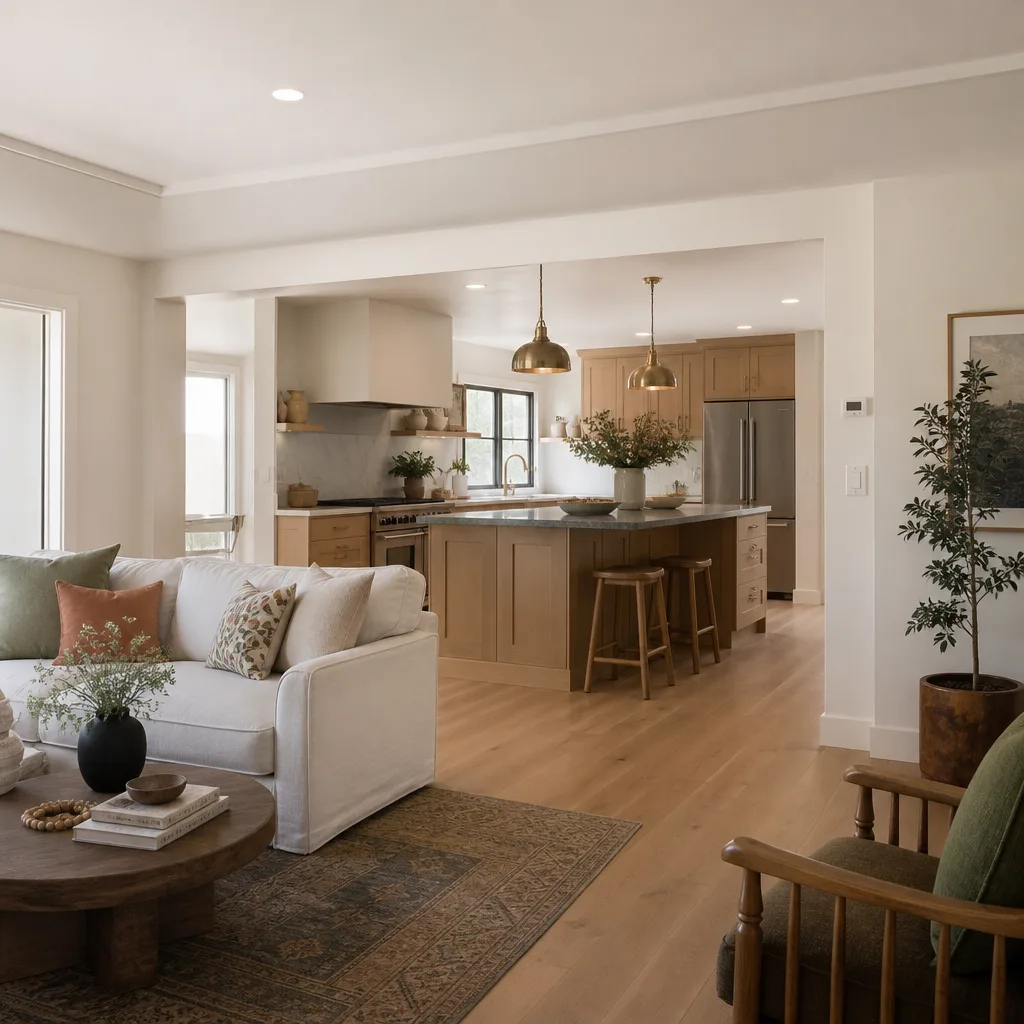
Every general contractor in Los Angeles builds a bid from the same five buckets. The difference between a $62,000 kitchen and an $85,000 kitchen for the same floor plan is rarely the cabinets. It’s how each bucket is calculated, and whether the contractor shows you the math or keeps it vague.
- Materials (with markup): Cabinets, tile, countertops, fixtures, lumber, drywall, paint. Most Los Angeles contractors mark up materials 10 to 20 percent. That markup covers procurement time, delivery coordination, storage, and the risk of a damaged sheet of drywall or a chipped tile arriving on site.
- Labor (with burden): The hourly or square-foot rate the crew is paid, plus payroll taxes, workers’ compensation insurance, and liability coverage. In California, labor burden typically adds 25 to 40 percent on top of a worker’s base wage. A carpenter paid $35 an hour may cost the contractor $48 when burden is fully loaded.
- Subcontractor coordination: Electrical, plumbing, and HVAC are almost always subcontracted in Los Angeles. The GC charges a coordination fee, usually 10 to 15 percent of each sub’s invoice, for scheduling, sequencing, quality checks, and the administrative work of keeping inspections moving.
- Permits and inspections: LADBS fees in 2026 generally run 1 to 3 percent of total project cost for remodels, and closer to 3 to 5 percent for additions where new square footage triggers plan check and structural review. Some bids include these as a line item. Some bury them in overhead. You want them itemized.
- Overhead and profit: Office rent, vehicles, phones, insurance, software, and the contractor’s margin. In Los Angeles, overhead and profit together typically run 15 to 25 percent of the total bid. Below 15 percent, the contractor is either cutting corners or will try to make it up on change orders.
We write every Elmstead Remodeling bid with these five buckets spelled out in plain language. You’ll see the KraftMaid cabinet line, the Silestone slab, the Schluter waterproofing membrane, and the labor rate attached to each. When a homeowner asks why our number is higher or lower than another bid, we can show them exactly where the difference lives. Read our General Contractor in Los Angeles page for more on how our written price process works.
2026 Los Angeles Labor Rate Ranges by Trade
Labor is the largest cost in most Los Angeles remodels, and rates vary meaningfully by trade. Here’s what you should expect to see on a line-item bid in 2026, based on work we’ve priced across the city this year.
- Framing carpentry: $55 to $85 per hour, or $9 to $15 per square foot for structural work. Seismic retrofitting requirements in older Los Angeles homes can push framing costs up when shear walls and hold-downs are added.
- Tile installation: $12 to $25 per square foot for floor tile, $18 to $35 per square foot for shower walls and waterproofing. Los Angeles homes built before 1980 often have uneven subfloors that require additional prep work, which is a cost a good bid will show you upfront.
- Electrical: $90 to $150 per hour, or $75 to $110 per outlet added. Rewiring an older Los Angeles home with knob-and-tube or cloth wiring can add $8,000 to $20,000 to a whole-home remodel, and this is a number you want surfaced before demolition starts.
- Plumbing: $95 to $160 per hour. Moving a kitchen sink or relocating a shower drain in a slab foundation is expensive work in Los Angeles, often $3,000 to $7,000 per fixture move depending on access.
One factor that surprises Los Angeles homeowners: California prevailing wage laws. If your project touches any public funding source, or if the property is being converted to a rental of a certain size, prevailing wage rates can push labor costs 30 to 50 percent higher. A contractor who flags this early is being honest with you. One who discovers it mid-project is not.
We’ve had families in Elmstead Remodeling home service areas in Silver Lake and Sherman Oaks ask us to price the same kitchen twice: once for a standard remodel and once with the assumption that they might later convert a guesthouse to an ADU. The labor line moves dramatically, and it’s better to know that before the crew arrives than after the concrete is open.
Written Line-Item Bids vs. Allowance-Heavy Estimates
The fastest way to compare two Los Angeles remodeling bids is to look at how many line items say “allowance” versus how many name an actual product and a unit cost. An allowance is a placeholder number the contractor intends to refine later. A line item is a commitment.
Here’s an example from two real bids we’ve seen on similar Los Angeles kitchens:
- Bid A: “Kitchen cabinets: $18,000 allowance.” This number could cover a KraftMaid line at a mid-tier price point, or it could cover a stock cabinet ordered from a big-box store with a 30 percent margin stacked on top. The homeowner has no way to know.
- Bid B: “KraftMaid Vantage line, maple, soft-close, 22 cabinets, installed: $21,400.” With this, the homeowner can look up the cabinet line, check the square footage of storage they’re getting, and compare against KraftMaid’s published dealer pricing.
The $21,400 bid is more expensive and more honest. The $18,000 bid is cheaper and more likely to become $24,000 once “the actual selection” gets made. Allowances have a place in a remodel when the homeowner genuinely hasn’t chosen a finish yet. They should never be the dominant structure of the bid, and they should always carry a stated ceiling.
At Kitchen Remodeling in Los Angeles projects, every Elmstead bid names the product lines before work starts. You’ll see Wellborn or KraftMaid for cabinets, Cambria or Silestone for countertops, Kohler or Moen for fixtures. The price we write is the price you pay, unless you change the scope. That’s the written price promise, and it’s stamped on every project.
Permit Fees and LADBS Structures in 2026
Los Angeles Department of Building and Safety permits are a smaller line item than most homeowners expect, but they carry an outsized effect on the schedule and the legality of the work. For a typical interior remodel in Los Angeles, permit fees run $1,500 to $4,000 depending on valuation and scope. For an addition, expect plan check fees, structural review, and title-24 energy compliance to push that number to $5,000 to $12,000.
What many bids don’t show is the soft cost of permits: the time a project coordinator spends at LADBS counters, the re-inspection fees when a detail doesn’t pass the first time, the weeks of delay if drawings need revision. Some contractors bury this in overhead. We itemize it. You should ask for it either way.
More importantly, ask this question directly: “Does your bid include pulling permits?” In Los Angeles, unpermitted work is common and expensive to fix when you sell the house. A contractor willing to skip permits to save you $2,000 is saving you a small amount now and potentially costing you tens of thousands in disclosure problems later. No contractor at Elmstead will ever suggest skipping permits. It’s not how we work, and it’s not how a responsible Los Angeles remodel gets done.
Fixed Written Price vs. Time-and-Materials: What Each Structure Actually Protects
A fixed written price means the contractor assumes the risk of estimating wrong. A time-and-materials contract means the homeowner assumes that risk. Both structures have a legitimate place, but they protect different parties.
A fixed written price is right for most remodels: a defined scope, a known floor plan, materials that can be selected before work starts. The homeowner knows the number before demolition, and the contractor’s incentive is to work efficiently. If the job takes longer than expected, the contractor eats the overage. This is the structure we use at Elmstead for every kitchen, bath, and whole-home remodel we price.
Time-and-materials is genuinely appropriate for discovery-heavy work: a 1920s Los Angeles house where you won’t know what’s inside the walls until they’re open, a foundation issue that needs engineering feedback after excavation, a termite repair that expands once the damage is exposed. In those cases, the contractor can’t responsibly commit to a fixed number, and the homeowner agrees to pay for actual hours and actual materials plus an agreed markup. The key is that the markup is defined in writing before work starts, usually 15 to 20 percent, and that the contractor provides weekly receipts and labor logs.
Where homeowners get hurt is a hybrid of the two: a “fixed price” bid with a clause allowing the contractor to bill for “unforeseen conditions” without defining what counts as unforeseen. We’ve looked at competitor contracts with language so broad it effectively converts a fixed bid into time-and-materials once the first wall is opened. Read that paragraph carefully. If the contract says the price can change for anything “not visible at the time of bid,” you are signing a time-and-materials contract with extra steps. There is a cabinet brand called Dvele that has made a name for itself in the prefab space, and while we build on-site rather than in a factory, we share their philosophy on this one point: the homeowner should know the number before the work begins.
When to Call a Pro
If your remodel touches electrical panels, gas lines, or load-bearing walls, you need a licensed general contractor. That is true even if the rest of the job seems manageable. Los Angeles requires permits for these scopes of work, and the liability of getting it wrong sits with the homeowner who skipped the professional. We’re not going to give you a step-by-step for rewiring a panel, because the safe answer is to hire someone who carries the license and the insurance.
You should also call a pro when the job involves moving plumbing in a slab floor, which is common in Los Angeles mid-century homes. Cutting into a post-tension slab without knowing where the cables run is genuinely dangerous. That’s a foundation failure waiting to happen, and it’s the kind of thing that turns a $6,000 bathroom remodel into a $40,000 structural repair.
Related services in Los Angeles: Bathroom Remodeling in Los Angeles if you’re tackling a smaller project first to test a contractor, or our main Elmstead Remodeling page for whole-home work.
The Bottom Line
Los Angeles remodeling costs in 2026 are driven by five things: the materials you choose, the labor burden your contractor carries, the subcontractor coordination you’re paying for, the permits LADBS requires, and the overhead and profit margin that keeps a contractor in business. A bid that hides any of those five is not cheaper. It’s just less honest about where the money goes.
What protects a Los Angeles homeowner is a written, line-item price with named products and a fixed number before demolition starts. That’s the standard we hold at Elmstead Remodeling, and it’s why we put the written price on paper before any work begins. If you’re planning a remodel in Los Angeles and want an estimate that shows you exactly what you’re paying for, call us at (949) 850-9896. Graham and the team will walk you through the numbers line by line.
Frequently Asked Questions
Most Los Angeles general contractors charge between $250 and $450 per square foot for a full remodel in 2026. The range reflects material selections, labor burden, and whether the contractor is bidding a finished-scope remodel or a rough-scope estimate padded with allowances. A line-item bid will show you exactly where your square-foot number lands and why.
Permit fees for a Los Angeles remodel typically run 1 to 3 percent of total project cost. Additions run higher, 3 to 5 percent, because they trigger plan check and structural review through LADBS. Ask your contractor to itemize permits as a separate line so you know exactly what the city is charging and what the contractor is passing through. Call (949) 850-9896 if you want us to price permits for your specific scope.
The difference is usually in three places: the labor burden the contractor is actually paying (workers’ comp and payroll taxes vary widely), whether the bid uses real product line items or vague allowances, and whether demolition disposal and permit coordination are included or treated as add-ons. The cabinets in both bids are often the same. The structure around them is not.
For a defined-scope remodel with known materials, a fixed written price is better for the homeowner because it transfers estimating risk to the contractor. Time-and-materials is genuinely appropriate for discovery-heavy work like opening walls in a 1920s Los Angeles house, but the markup should be defined in writing before work starts. If you’re not sure which structure your project needs, call (949) 850-9896 for a free conversation about your scope.
Written by Graham Stein, Owner at Elmstead Remodeling, serving Los Angeles since 2005.
Need Construction Help?
Call Elmstead Remodeling - licensed & insured, here with fast after-hours help in Los Angeles.
(949) 850-9896