Last updated October 8, 2026



Free written scope consultation - allowances, timeline, and change-order rules on paper before a single trade is scheduled
DIY vs Professional Bathroom Remodeling: What’s Safe to Do Yourself
Here is a number that surprises most Los Angeles homeowners: a shower pan liner costs between $80 and $150 at any local tile supply yard. The labor to install it correctly, with the proper pre-slope, corner dams, and flood test, runs $1,200 to $2,400. That gap looks like savings until you understand what a failed liner does. In Los Angeles, where older homes on raised foundations are common and a slow leak can travel along floor joists for months without detection, a DIY waterproofing mistake becomes a structural repair bill that starts around $8,000 and climbs. This guide walks you through exactly where the safe line sits in a bathroom remodel: what you can legally and safely do yourself in California, what requires an owner-builder permit, and what belongs with a licensed contractor.
Styles & brands we work with
Quick Answer
In a bathroom remodel, you can safely DIY the dry-zone cosmetic work: painting, swapping hardware, replacing a vanity light with a permit, and setting a new toilet when the existing flange height is correct. You should hire a licensed contractor for everything at or below the waterproofing layer in wet zones: shower pan installation, wall substrate prep behind tile, and any plumbing or electrical rough-in work, because self-performed errors in those areas create latent defects that can void insurance claims and follow the home through a future sale in California.
Table of Contents
- The Three Tiers of DIY Bathroom Work in California
- Why Shower Waterproofing Is the One Task Where DIY Skill Level Does Not Matter
- What California’s Owner-Builder Permit Actually Allows and Requires
- The Honest Cost Comparison for DIY Tile Installation
- The Three Bathroom Tasks Where DIY Almost Always Saves Real Money
- Demo, Electrical, and Plumbing: What You Can Touch and What You Cannot
- Common Mistakes to Avoid
- When to Call a Professional
- Frequently Asked Questions
- The Bottom Line
The Three Tiers of DIY Bathroom Work in California
The line that separates safe DIY from dangerous DIY in a bathroom falls exactly where water does. Everything above the waterproofing membrane in a dry zone, meaning away from the shower and tub surround, can often be owner-performed without a permit or with a simple electrical permit. Everything at and below the waterproofing layer in a wet zone carries consequences that outlast the weekend and follow the house through future sales. We see this pattern across every Los Angeles neighborhood we work in, from Echo Park bungalows to Sherman Oaks ranch houses. The principle never changes.
Tier 1: Safely DIY Without a Permit
- Painting walls, ceilings, and trim with bathroom-rated paint
- Replacing a standard toilet when the flange height is already correct and no plumbing rough-in changes are needed
- Swapping cabinet hardware, towel bars, mirrors, and robe hooks
- Replacing a bathroom exhaust fan with a like-for-like unit in the same opening, no new duct work
- Caulking around a tub, sink, or existing tile with silicone sealant
- Removing and replacing a vanity top and sink, provided the supply lines and drain connection remain in the same positions
- Installing peel-and-stick flooring or floating vinyl plank over a sound, level subfloor
These tasks do not require a permit from the Los Angeles Department of Building and Safety, which means no inspection, no disclosure obligation, and no risk to a future sale. The common thread: none of these tasks alter the waterproofing envelope, the plumbing rough-in, or the electrical wiring behind the wall.
Tier 2: DIY With an Owner-Builder Permit in California
- Replacing a bathroom vanity light fixture where the junction box already exists
- Installing a new GFCI outlet or moving an existing outlet a few feet within the same wall cavity
- Replacing shower valve trim (not the rough-in valve body) where water lines stay put
- Setting tile on a bathroom floor when a properly sloped and waterproofed substrate already exists
- Replacing an existing bathtub with a new tub in the same footprint when the drain location does not move
California Business and Professions Code Section 7044 allows a homeowner to act as their own contractor and pull owner-builder permits for work on their principal residence. The permit process in Los Angeles requires passing a basic owner-builder verification for certain scopes, but the larger obligation is the disclosure one. Find more guides & resources on this below, because it is the part most YouTube renovation channels never mention.
Tier 3: Licensed Contractor Work Only
- Shower pan installation and sloped mortar beds
- Wall substrate replacement behind tile in a wet zone, including cement board and waterproofing membrane application
- Moving drain lines, supply lines, or vent stacks
- Adding or relocating electrical circuits, especially anything tied to the load center
- Structural changes: removing a load-bearing wall, altering ceiling framing, or enlarging a window or door opening
- Any work involving gas lines, including relocating a gas water heater that serves the bathroom
These tasks sit in Tier 3 not because homeowners lack intelligence or care. They sit there because the failure mode is hidden, slow, and expensive, and because self-performed errors in these scopes are specifically called out in standard California real estate disclosure documents and in many homeowner insurance policies. Graham Stein, owner at Elmstead Remodeling home, puts it plainly: “The jobs that can hurt you are never the ones that go wrong in front of you. They are the ones that go wrong behind the tile.”
Why Shower Waterproofing Is the One Task Where DIY Skill Level Does Not Matter
A homeowner in California can legally paint their own bathroom, install their own vanity light with a permit, and set their own toilet. But a shower tile installation over improperly applied waterproofing is a latent defect that may not show as a leak for 18 months and can void a homeowner’s insurance claim if self-performed work is the cause. This is the single most important paragraph in this guide. Read it twice.
The reason DIY skill is genuinely irrelevant to shower waterproofing risk is structural, not motivational. The failure mode is invisible by definition. A first-time tile setter can produce a shower that looks flat, plumb, and well-grouted while the waterproofing behind it has voids, pinholes, or an incorrectly lapped corner. Water penetrates grout, which is porous by design. It then meets the waterproofing layer, which is the actual water barrier. If that layer has a pinhole at a corner or an improper seam at the wall-to-floor transition, water moves into the wall cavity. It does not drip. It does not puddle. It wicks, evaporates, and feeds mold inside the framing, and the homeowner discovers it when the baseboard on the opposite side of the wall starts to swell, or when a floor joist in the crawlspace shows rot during a termite inspection.
The insurance angle is the part most DIY guides skip. Standard California homeowners insurance policies contain exclusions for continuous or repeated seepage and for faulty workmanship. If a shower leak caused by homeowner-performed waterproofing leads to mold remediation and structural repair, the insurer will investigate the causal origin. Self-performed work is one of the first things the adjuster asks about, and it is one of the most common reasons a water damage claim gets denied.
In Los Angeles specifically, the housing stock makes this worse. Many homes in neighborhoods like Highland Park and Mar Vista were built in the 1940s and 1950s with dimensional lumber framing and no moisture barrier between the wall cavity and the exterior stucco. A slow shower leak in one of these homes does not need to travel far to reach structural wood. The warm, dry Los Angeles climate also means the water often evaporates before it stains, which extends the detection timeline even further. By the time anyone sees a problem, the damage is done.
Our recommendation is not a pitch. It is a risk decision. If you are going to DIY a shower, buy a pre-sloped, pre-waterproofed shower kit from a manufacturer like Schluter or Wedi, follow the installation instructions exactly, and flood-test the assembly for 24 hours before any tile goes up. If any part of that sentence makes you uncomfortable, call a contractor who does this weekly. The $1,500 to $2,500 in professional waterproofing labor is the cheapest insurance policy you will ever buy on the house.
What California’s Owner-Builder Permit Actually Allows and Requires
California allows a homeowner to pull an owner-builder permit for work on a residence they occupy or intend to occupy. Many Los Angeles homeowners use this route for bathroom remodels that include electrical and plumbing changes, believing it saves them money and gives them legal cover. That is true. What they often do not know is the disclosure obligation that travels with the permit.
Under California Business and Professions Code Section 7044, an owner-builder who pulls a permit for structural, plumbing, or electrical work must disclose that owner-builder status to any buyer within the first ten years after the permitted work is completed. The disclosure is part of the standard transfer disclosure process. It does not prohibit the sale, but it puts the buyer on notice that the work was performed by the homeowner rather than a licensed contractor. In a competitive Los Angeles market, that disclosure can change the conversation at the closing table.
Here is what the owner-builder process actually looks like in Los Angeles:
- You submit plans or a permit application to the Los Angeles Department of Building and Safety for the specific scope: electrical, plumbing, or both.
- For electrical work, you pass an owner-builder electrical certification, which is a basic code knowledge test administered through the department.
- You pay permit fees, which for a bathroom electrical and plumbing scope in Los Angeles typically run $400 to $900 depending on fixture counts.
- You perform the work, scheduling rough-in inspections before walls close and a final inspection after fixtures are set.
- You keep the permit, the inspection sign-offs, and the disclosure obligation for the next ten years.
The permit process itself is not the hard part. The hard part is the liability that survives the final inspection. An inspector checks for code compliance at the moment of inspection. They do not warranty the work. They do not catch every latent defect. And they are not liable if a soldered joint fails in year three or a GFCI circuit has a loose neutral that causes nuisance tripping. The owner-builder is.
We mention this not to discourage the permitted DIY route, but to frame it accurately. The owner-builder permit is a legal permission slip, not a quality guarantee. For dry-zone electrical swaps like a vanity light or an added GFCI outlet, it is a reasonable path. For a full bathroom gut with moved plumbing and a new shower valve, the risk profile changes materially. Graham Stein has walked more than one Los Angeles homeowner through the math: the owner-builder savings on a full bathroom typically ranges $6,000 to $12,000, while the cost of repairing a failed shower valve or a leaking drain joint behind finished tile starts at $4,000 and can triple from there.
The Honest Cost Comparison for DIY Tile Installation
Let us look at the actual numbers for a 60-square-foot bathroom floor, which is typical for a standard 5-by-7-foot hall bath in a Los Angeles home. The material cost is identical whether you or a professional does the work: the tile itself, thinset, grout, and backer board run $8 to $15 per square foot for mid-range porcelain. The difference is entirely in labor, experience, and the cost of mistakes.
- Materials for 60 square feet of floor tile: $480 to $900, depending on tile selection
- Professional installation labor in Los Angeles: $9 to $16 per square foot, or $540 to $960 for a 60-square-foot floor
- DIY cost: time and mistakes: a first-timer typically spends two full weekends on a bathroom floor, including demo of the old floor, subfloor prep, layout, setting, and grouting
- Tool cost if not already owned: a wet saw or a good snap cutter, trowels, leveling clips, and a grout float total $150 to $400
- Cost of a redo if lippage or layout goes wrong: the full material cost again, plus another weekend
Professional tile setters in Los Angeles charge what they charge because they know how to avoid lippage, which is the technical term for the height difference between adjacent tile edges. A properly set floor has lippage of less than 1/16 inch. A first-time DIY floor often has lippage of 1/8 inch or more at several tiles, which is visible in raking light and immediately noticeable to anyone walking barefoot. In a bathroom, where floor lighting often comes from a single vanity fixture that skims across the tile surface, lippage shows up as shadows. It is one of the first things a buyer notices at an open house.
The math on a shower floor is even starker. A 60-square-foot shower floor with a center drain requires cutting tiles at compound angles to follow the slope. First-timers routinely waste 15 to 20 percent of the tile on miscuts, which erases the material savings entirely. And the waterproofing underneath the shower floor is the Tier 3 issue we covered above. We have been called in to fix DIY shower floors where the homeowner spent $1,200 on tile and two weeks of evenings, only to discover the floor was not sloped correctly and water pooled in the corner. The fix required demoing the entire shower floor, re-flood-testing the pan, and resetting the tile. The total professional bill was $4,800, all of which could have been avoided with a $2,900 professional installation from the start. That is the kind of math that makes a free estimate worth an hour of your time. Bathroom remodeling in Los Angeles does not have to be a six-week mystery; a written price before any work starts removes the guessing entirely.
The Three Bathroom Tasks Where DIY Almost Always Saves Real Money
We do not want this guide to read as a blanket warning against touching your own bathroom. There are three tasks where DIY savings are real, the risk is low, and the result is nearly indistinguishable from professional work. None of these tasks touches waterproofing, plumbing rough-in, or electrical wiring, which is why they are safe.
1. Painting Bathroom Walls and Ceilings
A professional painter in Los Angeles charges $400 to $800 to paint a small bathroom. The paint itself, a high-quality bathroom-rated line like Benjamin Moore Aura Bath & Spa or Sherwin-Williams Duration with mildew resistance, costs $60 to $90 a gallon. A small bathroom takes one gallon for walls and most of a second for a ceiling and trim. The total DIY cost is $120 to $180 and a single afternoon. The key is surface prep: sand any glossy surfaces lightly, use a stain-blocking primer on water spots, and choose a satin or semi-gloss sheen that resists moisture. No permit required, no disclosure obligation, no hidden failure mode.
2. Swapping Hardware, Mirrors, and Faucets in Place
Replacing a tired towel bar, a builder-grade mirror, or a bathroom faucet where the supply lines and shut-off valves already exist is a one-afternoon job that costs $70 to $250 in parts. Kohler and Moen faucets are at the higher end of that range, with manufacturer warranties that travel with the fixture. The DIY savings versus a professional handyman is $150 to $400 per fixture. The only rule: if the shut-off valves under the sink do not hold, stop and call a plumber before you unscrew anything. A stuck or leaking angle stop turns a simple faucet swap into a water event.
3. Setting a New Toilet When the Flange Is Already at the Correct Height
A toilet replacement where the existing closet flange sits on top of the finished floor and is not cracked, rusted, or low is a legitimate DIY job. A good toilet costs $250 to $500. A plumber charges $350 to $600 for the installation. The DIY work involves turning off the water, draining the tank, removing two closet bolts, lifting the old toilet, replacing the wax ring with a modern rubber seal, and setting the new toilet. Most homeowners finish in under two hours. The critical check: before you buy the new toilet, measure the rough-in distance from the wall to the center of the closet bolts. It is almost always 12 inches, but some Los Angeles bungalows have 10-inch rough-ins, and buying the wrong toilet turns a two-hour job into a plumber call for a flange relocation.
These three tasks share a common characteristic: the failure mode, if any, is visible immediately. Paint drips are visible. A dripping faucet is visible. A wobbling toilet is visible. You fix it on the spot. Nothing hides behind a wall for 18 months.
Demo, Electrical, and Plumbing: What You Can Touch and What You Cannot
Demo is the siren song of bathroom remodeling. It looks like the easiest money saved: swing a hammer, pull some tile, haul the debris, and the contractor’s estimate drops by $800. The reality in Los Angeles is more complicated, because demo work in a bathroom almost always intersects with the building envelope and with materials that carry health regulations.
What you can demo safely: tile off dry-zone walls like the wall behind a vanity or above a wainscot height that does not get direct shower spray, vinyl flooring over a sound plywood subfloor, a standard cabinet and countertop, and a non-load-bearing wall if you have verified it carries no load. The verification is the catch. In many Los Angeles ranch houses, the wall between the hall bath and the hallway is a shear wall, which means it carries lateral loads even if it does not carry vertical loads. Cutting into it without knowing what you are looking at is how small demos become structural repairs.
What to leave alone: any wall or floor in an older home that could contain asbestos. Homes built in Los Angeles before 1981 have a meaningful probability of asbestos in drywall joint compound, vinyl flooring, or the mastic under old tile. Disturbing it without testing and, if positive, abatement, creates an airborne hazard for your family and a legal disclosure obligation for you. A California homeowner who knows or should know of asbestos and fails to disclose it faces real liability at sale. Universal Environmental of Los Angeles offers do-it-yourself asbestos test kits that start around $50 if you want to know before you swing a hammer.
Electrical: California allows a homeowner to replace existing devices like outlets, switches, and light fixtures without a permit. A like-for-like swap, meaning the new fixture uses the existing junction box and the same circuit, is legal DIY with an owner-builder electrical permit in Los Angeles where the city requires one. What is not legal DIY: adding a new circuit, running new wire inside walls, moving an outlet, or doing anything inside the load center. These require a licensed electrician, and the work is inspected. The most common mistake we see in Los Angeles bathrooms is a homeowner installing a new exhaust fan on an existing circuit that is already loaded, which causes nuisance breaker trips for years until an electrician runs a proper dedicated circuit.
Plumbing: The legal line for California DIY plumbing is surprisingly clear. A homeowner may replace a faucet, a toilet, a shower head, or a P-trap on their own residence without a permit. They may not modify, extend, relocate, or rough-in any drain, waste, vent, or supply line without an owner-builder plumbing permit, and those permits require inspections that must pass before walls close. The practical line is even more important than the legal one: any plumbing joint you cannot see after the wall closes is a joint you need to trust for decades. A professional plumber tests everything with a pressure gauge before closing. A homeowner cannot. That is the difference between a joint that leaks in year two behind a finished wall and a joint that never leaks.
Common Mistakes to Avoid
- Skipping the flood test on a DIY shower waterproofing job. A 24-hour flood test is the only way to know whether a waterproofing assembly holds. Every professional does it. Almost no first-timer does. If you will not do the test, do not do the work.
- Using drywall instead of cement board or a foam backer behind shower tile. Green board and even mold-resistant drywall are not waterproof. They are water-resistant until the first pinhole breach, then they fail. We see this mistake in Los Angeles bathrooms where a previous owner did a quick flip remodel, and the tile is already cracking along the seams.
- Buying the wrong toilet rough-in size. The measurement from the finished wall to the center of the closet bolts is not always 12 inches. In older Los Angeles homes, 10-inch and 14-inch rough-ins are common. Buying a 12-inch toilet for a 14-inch rough-in leaves a gap, and buying one for a 10-inch rough-in means it will not fit at all.
- Moving electrical outlets without pulling a permit. In Los Angeles, unpermitted electrical work discovered during an inspection or after an incident triggers a correction order, and the homeowner pays double fees or worse to fix it. A permit costs less than most people think and keeps the work legal.
- Ignoring the owner-builder disclosure obligation. That owner-builder permit follows the house. If you sell within ten years and do not disclose, and the buyer has an issue with the work, you have created a legal exposure you never needed. Disclose every time.
- Over-valuing tile savings while under-valuing layout skill. The material cost savings on a DIY tile job are real and usually small. The visual cost of poor layout at an open house is always larger. A buyer remembers a crooked tile line long after they forget the asking price.
- Starting demo before asbestos testing in a pre-1981 home. The test costs around $50. The abatement, if you skip testing and contaminate the house, costs thousands and requires professional remediation. In Los Angeles, where mid-century homes dominate neighborhoods like Westchester and Studio City, this is a daily risk.
When to Call a Professional
Call a professional when the work touches the waterproofing layer in a wet zone, when any plumbing or electrical rough-in is moving rather than swapping in place, when the wall you want to remove might be structural, or when you have discovered water damage, mold, or asbestos during demolition. These four scenarios share a common trait: getting them wrong creates costs that dwarf the savings of doing it yourself, and the worst outcomes are hidden, deferred, and irreversible without major reconstruction.
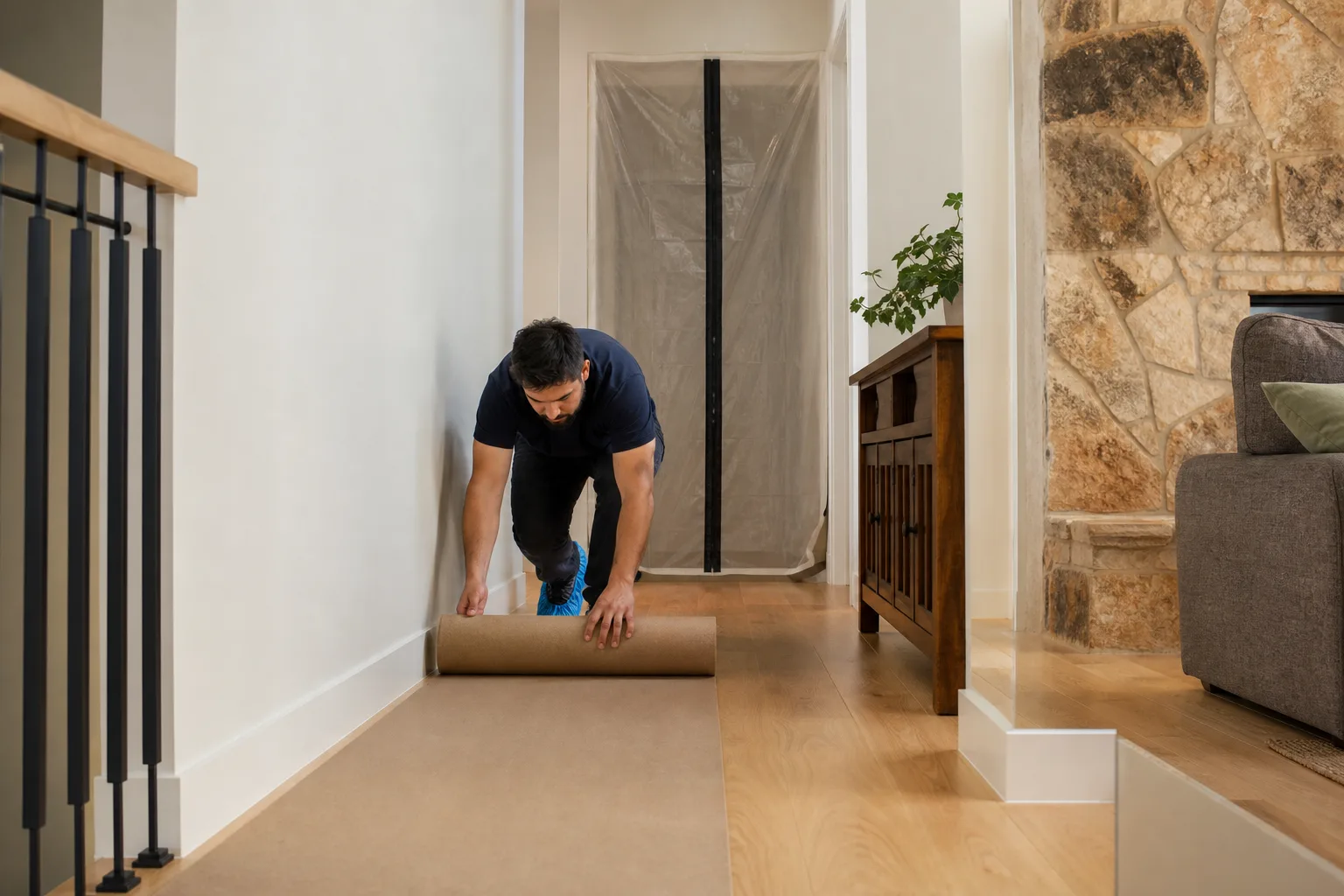
General Contractor in Los Angeles work on a bathroom does not have to be a gamble. Elmstead Remodeling offers free estimates in Los Angeles, call (949) 850-9896, and a written price is given before any work starts, every time. The written price is the point: no estimates that grow after the crew arrives, no change orders that appear out of nowhere, and no surprises when the job is done. The 365-Day Done Right Promise covers every completed project, and the Cedarwell Care Promise shapes how the crew works: drop cloths on the floors, shoe covers at the door, quiet tools during family rest hours where possible, and pet-safe products where there is a choice. A photo of the clean-up before the crew leaves is included on every job, so the family knows exactly how the house was left.
Frequently Asked Questions
Yes. California allows homeowners to perform most cosmetic bathroom work without a permit and to pull owner-builder permits for electrical and plumbing work on a residence they occupy. The limit is structural, plumbing, electrical, and waterproofing scope that requires a licensed contractor. If you do pull an owner-builder permit, remember the ten-year disclosure obligation when you sell the home.
Shower waterproofing is the hardest and the most unforgiving. The failure mode is hidden behind tile, often for a year or more, and by the time it shows, the repair involves demoing the shower and addressing structural damage. A 24-hour flood test before tiling is mandatory if you attempt it yourself, and many skilled homeowners decide the risk is not worth the savings.
A mid-range full bathroom remodel in Los Angeles typically runs $18,000 to $35,000, including demolition, plumbing and electrical updates, waterproofing, tile, fixtures, and finish materials. A cosmetic refresh, meaning paint, hardware, a new vanity, and a new toilet, can run $4,000 to $9,000. These are broad ranges; the only way to get an accurate number for your specific bathroom is a written estimate, which Elmstead Remodeling provides at no cost. Call (949) 850-9896 to schedule a free estimate.
No permit is required to replace an existing toilet when the closet flange is in good condition and the new toilet fits the existing rough-in measurement. The work is considered a like-for-like fixture replacement. If the flange is cracked or low and needs to be replaced or reset, a plumber should handle the repair, but a permit is still not typically required for a flange replacement on an existing waste line.
A seller is legally obligated to disclose unpermitted work on the transfer disclosure statement. Failure to disclose creates liability after the sale if a problem arises. Even with disclosure, some buyers and lenders balk at unpermitted electrical work, and the buyer may use it to negotiate the price. The homeowner’s remedy is to pull a permit retroactively, which involves opening walls for inspection and paying the permit fees, or to discount the sale. The cheaper path is to pull the permit the first time.
It may not. Standard California homeowner’s policies exclude damage caused by faulty workmanship and by continuous or repeated seepage. If a DIY shower waterproofing failure leads to mold or structural damage, the adjuster will investigate the cause, and self-performed work is a common reason claims are denied. This is one reason waterproofing is a Tier 3, licensed-contractor scope even for capable DIY homeowners.
The Bottom Line
The line between safe DIY and risky DIY in a bathroom is not your skill level. It is the water. Paint your walls, swap your hardware, set your toilet, and take the savings. Leave the shower pan, the tile substrate, the moved plumbing, and the new circuits to a licensed contractor who works under permit and stands behind the work. The math in Los Angeles is consistent: a few thousand dollars in professional labor on the wet-zone scope is cheaper than the insurance denial, the structural repair, or the resale discount that follows a hidden failure. If you are weighing the choice on your own bathroom, see our DIY vs Professional General Contractor: What’s Safe to Do Yourself or get a free estimate first. A written number costs nothing and makes the decision concrete.
Written by Graham Stein, Owner at Elmstead Remodeling, serving Los Angeles since 2005.
See the difference
 Before
 After
After Before
 After
After Before
 After
After